
In quantum computing, scalability is the fundamental systems architecture challenge that must be overcome to reach the large volumes of logical qubits required to solve some of the world’s most complex and consequential problems. Architectures that can both scale up and scale out efficiently will be the best positioned to deliver high-performance, commercially viable quantum platforms. This combined approach overcomes the limits of traditional quantum scaling approaches by taking a systems engineering approach to hardware, networking, and entanglement distribution from the start for performant, scalable quantum systems.
Entanglement is the Quantum Resource
Quantum computing is accelerating toward commercial utility, dominated by one goal: large volumes of application-grade logical qubits capable of working together at scale to run useful algorithms. However, performing these kinds of algorithms involves more than just qubit volume and quality. It demands efficient connection between qubits, and distribution of entanglement across increasingly large qubit arrays.
Entanglement is the resource that fuels quantum computing; it is the ability to share a single quantum state regardless of distance, and it is the property that allows quantum computers to achieve exponential speedup. It therefore stands to reason that slow, inefficient entanglement distribution will eventually become a bottleneck for system performance. Any architecture that cannot distribute entanglement at scale will struggle to deliver commercial-grade performance, regardless of qubit count.
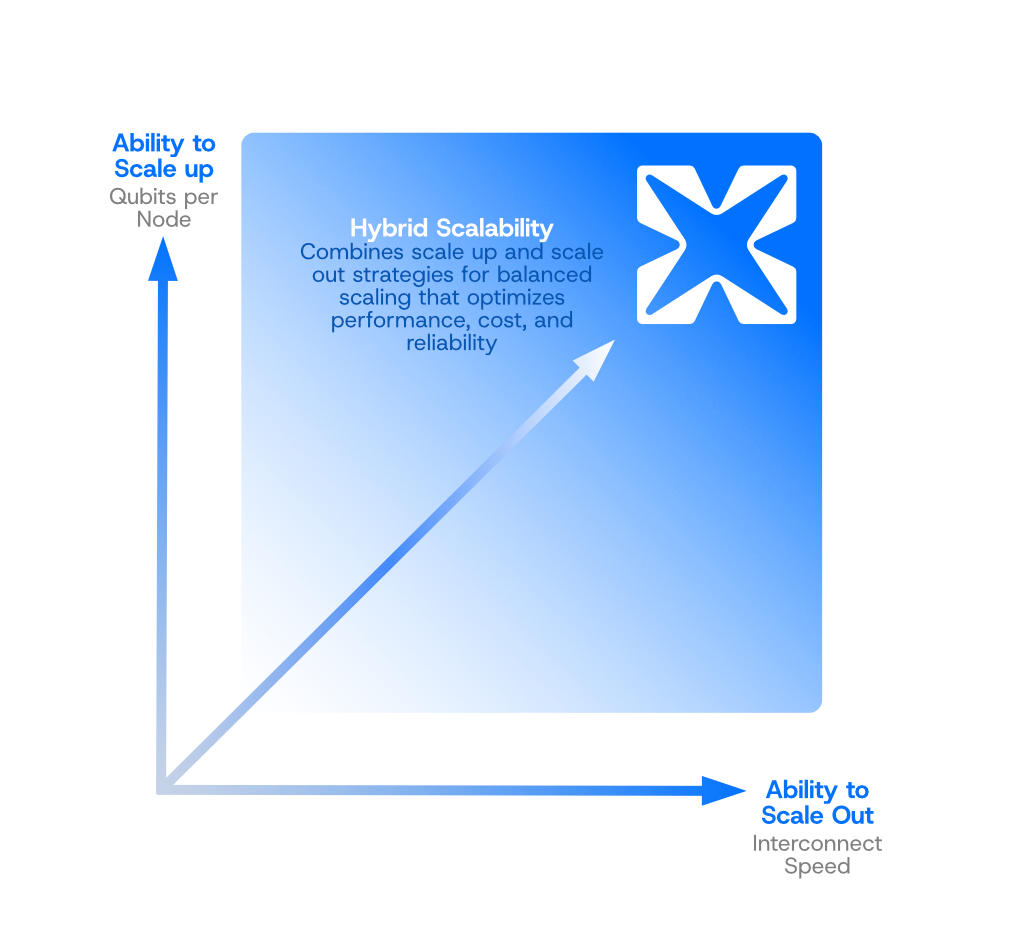
The path to practical quantum computing hinges on how systems scale, which is related to how well they can distribute entanglement across the entire system. Two distinct strategies are possible: scaling up (increasing qubit count and distributing entanglement within a single module) and scaling out (connecting multiple quantum processors or modules by distributing entanglement between them). Each approach offers advantages, and each has its constraints. The most scalable quantum systems, however, will have architectures that can do both.
Scaling Up: Increasing Density Inside a Quantum Module
Scaling up, or vertical scaling, focuses on improving qubit count and performance within a single quantum module. It is fundamentally a manufacturing and engineering challenge: take a proven qubit platform and make it smaller, denser, and more reproducible, without compromising performance. Most scale up roadmaps rely on high-density silicon platforms. Silicon offers compact footprints, well-understood fabrication methods and supply chains, and native integration with classical control electronics.
As attractive as scaling up may seem, there are fundamental physical and engineering factors that limit the size of any individual module. Thermal management, signal integrity issues, and/or control line congestion eventually constrain every modality. These limits appear at different points, depending on the technology, but they cannot be avoided.
While scaling up is a powerful strategy, it faces known limits on the path to commercially valuable, scalable quantum systems.
Scaling Out: Connecting Modules into a Distributed Quantum System
Scaling out, or horizontal scaling, increases total computational capacity by connecting multiple quantum processors into a larger, unified system. To scale out, modules must share entanglement. This approach mirrors classical distributed computing—but with a critical distinction. Quantum computing is not easily retrofitted for horizontal scale, and without an efficient entanglement distribution between the processors, a “system” of quantum processors remains limited by the computational ceiling of a single processor. This approach to scaling quantum systems introduces three new hurdles:
- Connectivity: Quantum modules cannot be connected as easily as CPUs; either ‘flying qubits’ (photons that can act as qubits) or movement of physical qubits between modules is required to distribute entanglement. Though photonic interconnects are by far the simpler method, not all qubit modalities have a native optical interface; some have microwave links, while others require transducer systems to generate optical photons for interconnects.
- Complexity: Maintaining coherence and synchronization across quantum modules is far more challenging than connecting classical processors. Without integrated entanglement management, complexity grows nonlinearly as more modules are added.
- Cost: Building large systems out of many lower-density modules can increase the cost of goods and operational overhead. Without careful design, complexity and cost can compound one another on the path to scalable quantum systems.
Architectures with a built-in optical interconnect have an advantage when scaling out. This is especially true for quantum computing systems that operate natively at telecom band wavelengths, as they do not require inefficient transduction hardware. These architectures can leverage existing telecom network infrastructure and technology to manage the complexity and cost of scaling out to decrease the cost of adding modules while increasing computing capacity dramatically.
While scaling out leverages the upsides of networked systems, it faces multiple challenges as a stand-alone strategy.
Why Combined Scaling Creates More Value
The lessons from classical computing are clear: the biggest leaps in computing power came when vertical and horizontal scaling advances converged. The same is true for quantum computing—but with efficient, reliable entanglement distribution as the defining systems constraint. A combined approach that integrates the high-density advantages of scaling up with the unbounded potential of scaling out offers the most promising and practical path to scalable quantum systems of commercial value. A combined strategy focuses on:
- Density gains within modules
- Capacity gains across modules
- System-level efficiency by mitigating the limits of each approach
Crucially, combined scaling enables quantum computers to grow without hitting an architectural ceiling. Quantum scaling becomes much easier—and more cost-effective—with photonic interconnects, particularly if they are native to the architecture. Built-in photonic links enable low-loss, high-speed connectivity, which is precisely what quantum systems need to distribute entanglement between modules. When paired with quantum memory and computation in a platform that can scale up, photonic connections unlock the possibility of truly scalable quantum systems.
Despite the need for connectivity to scale out, many current quantum computing architectures are unable to capitalize on scale out strategies as they lack native telecom optical interconnects and are faced with the difficult task of retrofitting interconnects.
An Architecture Purpose-Built For Scaling Quantum Computing
Photonic’s Entanglement First™ architecture is designed around a simple but essential insight: If entanglement distribution is a gating factor for scalable quantum systems, then it must be a foundational design principle—not an afterthought.
By using the same mechanism to distribute entanglement within a single processor and between processors, the architecture supports both vertical and horizontal quantum scaling. Additional features of the approach that contribute to the combined scaling strategy include:
- Silicon-based modules provide density, manufacturability, and performance for scaling up.
- Native photonic interconnects offer low-loss, high-speed entanglement distribution within and across modules, supporting scaling out.
- Quantum memory + compute + photonics work together in a single integrated fabric.
Leveraging existing technology in silicon manufacturing and telecommunications, this approach forges a clear path to economic viability on a commercial scale.
Quantum computing modalities differ in how well their core technology scales up and out. Different quantum architectures naturally fall in different regions of the “scale up vs. scale out” landscape. Some achieve impressive density inside a module. Others excel at connectivity. Some use a blend of both. Regardless of the approach, a pattern is emerging: architectures that cannot reliably distribute entanglement will face challenges as they reach maximum module density.
Commercial quantum computing is no longer a competition based solely on qubit counts—it’s a race to build systems that scale intelligently, efficiently, and economically. The winning architectures will be those that scale up efficiently, scale out natively, and distribute entanglement effectively. They will have little to no increase in marginal cost as the system grows, offering a path to scalable quantum systems—powerful, modular, and built for real-world applications.
Quantum scaling through a combined ‘scale up and scale out’ approach isn’t just a strategy. It’s a blueprint for the future of quantum computing.
Learn more about Photonic’s Entanglement FirstTM Architecture.