
Distributed Quantum
Computing in Silicon
Entanglement Between Modules
Developing performant quantum systems of commercial utility will require hundreds to thousands of logical qubits. To achieve this capacity, quantum systems must be modular due to the upper limits of qubit capacity in any single monolithic machine. Photonic is focused on overcoming the challenge of entanglement distribution as the key to unlocking the potential of quantum computing at scale. A recent publication showcases Photonic’s ability to distribute and consume entanglement between remote spins using telecom photons.
The Three Phases of Quantum Computing
The importance of quantum computing lies both in the promise of what quantum information technologies can deliver and the yet-to-be determined dominant design that ultimately moves the industry to performant systems. Quantum computer developers across science and industry are motivated by the same end goal — quantum technologies that can outperform classical systems for a select set of computational challenges with the potential for huge social and commercial impact.
Although specifics and definitions may vary, there is a consensus that the development of quantum technology toward viable commercial applications will progress through three distinct phases.
Phase 1: NISQ (“noisy intermediate-scale quantum”) phase: In this phase, the prototypes that emerged were restricted to a single module and contained too few qubits or too noisy qubits to implement quantum error correction effectively.
Phase 2: Monolithic, small-scale, fault-tolerant phase: In Phase 2, the technology is still limited to a single module, however qubit counts continue to increase, and noise has decreased enough that some number of error-corrected (logical) qubits can be implemented.
Phase 3: Large-scale, distributed, fault-tolerant phase: In Phase 3, quantum computers will have advanced to the point where they consist of multiple networked (or distributed) modules, each containing numerous logical qubits formed from physical qubits with noise levels below the threshold for quantum error correction. During this phase, large fault tolerant computations will be executed across a multi-module system.
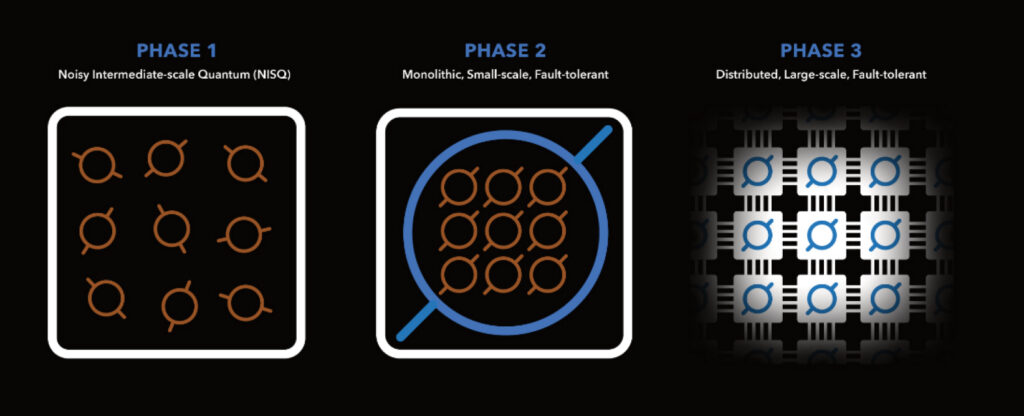
Multiple demonstrations of logical qubits on various platforms and at increasingly large scales indicate that the industry has firmly entered Phase 2. So far, the primary focus has been on improving the performance and capacity of logical qubits within individual quantum computers, rather than addressing the networkability of the platform.
Developing a system that meets the requirements of Phase 3 demands a comprehensive approach focused on both local and distributed capabilities. Photonic’s overarching goal is to create a system that inherently supports both distributed computing and communication. By designing compute and communicate capabilities into an integrated platform, Photonic can reduce both the number of accommodations and amount of quantum resources required to execute distributed quantum computations.
Distributed Entanglement: The Key to Networked Quantum Systems
Connectivity between quantum computing modules is crucial for the efficiency of the entire system, as it influences the quantum resources needed for operation. Bell pairs, which are generated and consumed for inter-module operations, serve as these essential quantum resources. Generally, the more Bell pairs available, the more operations can be performed. However, the system must be designed to efficiently generate and distribute Bell pairs to the necessary locations.
Bell pairs are pairs of qubits that are “maximally entangled,” serving as “the glue” that networks all quantum processors together. They can be consumed as part of the implementation of universal quantum algorithms. From a quantum resource estimation perspective, Bell pairs and CNOT gates are essentially equivalent — CNOT gates and single-qubit operations can be used to create Bell pairs, and Bell pairs combined with local operations can perform nonlocal (teleported) CNOT gates. In other words, Bell pairs can be used to execute quantum logic independent of physical location, provided they can be distributed to any physical location.
Demonstrating Distributed Entanglement
Large-scale quantum algorithms running across multiple quantum computers require enormous amounts of distributed entanglement to work well. Known algorithms (e.g., Shor’s algorithm) will require more qubits than can be feasibly contained in a single module (refer to the white paper — What could networks of quantum supercomputers look like? for insights into the significance of I/O quantity and quality).
Achieving this modular scalability mandates prioritizing highly parallelized entanglement distribution as a foundational aspect of the initial design. To achieve highly parallelized entanglement distribution, every candidate Phase 3 quantum computing platform must demonstrate the ability to distribute entanglement and execute operations between modules by consuming entanglement. Both capabilities are fundamental for building performant and scalable systems. Photonic has successfully demonstrated entanglement distribution and operation implementation between modules in a commercial setting using telecom fibres. Photonic’s path to demonstrating an inter-module operation involved three sequential steps, each building upon the successes of the last:
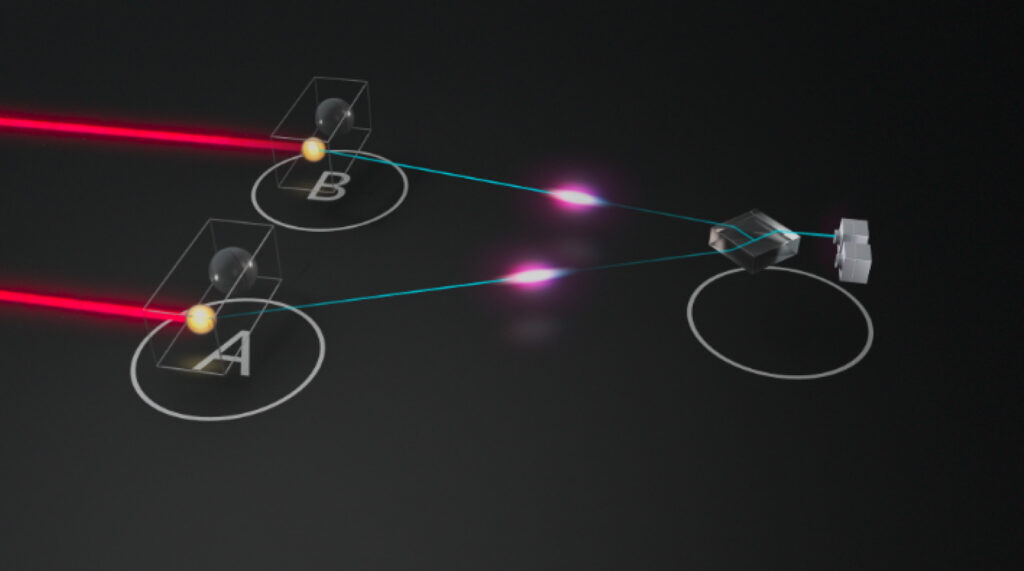
Photonic successfully established entanglement between two matter-based T centre communication qubits (electron spins) using photons.
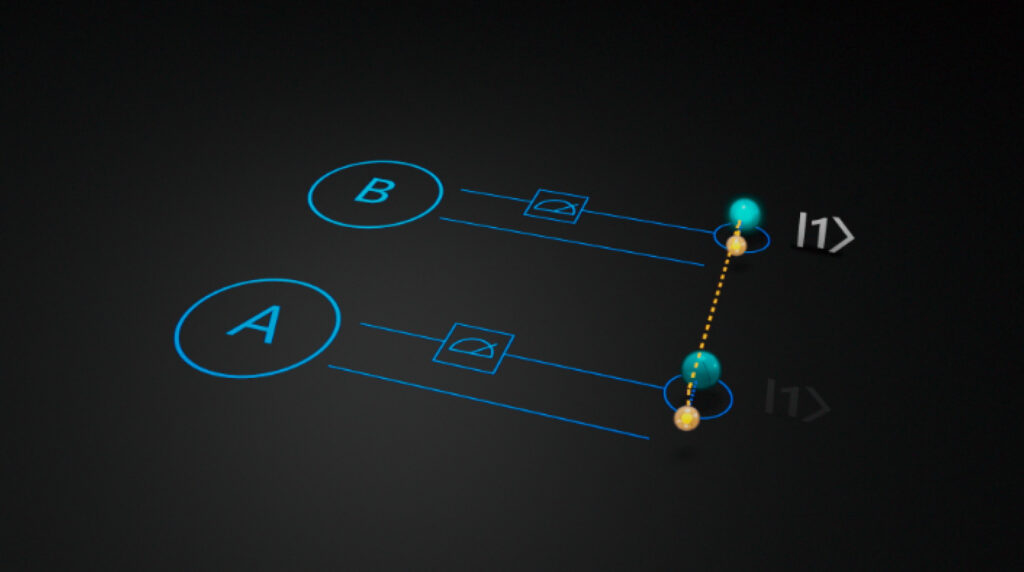
Distributed entanglement was used to perform a remote gate sequence. The teleported CNOT was executed between silicon-spin qubits located in different cryostats connected by telecom fibre.
- Hong-Ou-Mandel (HOM) protocol in the context of T centre distributed entanglement: Remote entanglement can be established via interference of two photons emitted by the qubits to be entangled. For this process to be successful, the photons emitted by two communication qubits (each in a T centre), must be indistinguishable — by wavelength, phase, or time of arrival. The ability to successfully emit two indistinguishable photons can be characterized by the HOM protocol. This step serves as a critical system calibration check to guarantee the potential success of future attempts to run an entanglement protocol such as Barrett-Kok.
- Barrett-Kok (BK) protocol with T centres: With confirmation from the HOM protocol that the system can successfully emit indistinguishable photons from separate T centres, the next step is to use the photons to establish entanglement between the emitting qubits. The BK protocol can be used here to entangle two matter-based T centre communication qubits (electron spins) using photons.
- Teleported CNOT between T centres: A0fter successfully establishing entanglement between communication qubits, this entanglement can be consumed to implement nonlocal (teleported) operations between memory qubits (nuclei) in the same T centres. These operations act on the memory qubits in two different T centres, which can be located in two separate cryostats, potentially separated by hundreds of kilometers. In this demonstration, a teleported CNOT sequence is performed on memory qubits located in two cryostats separated by 40m of optical fibre.
Beyond these accomplishments, Photonic achieved high coherence times and demonstrated physical operations (qubit initialization, readout, and local one- and two-qubit gates) needed for quantum computation. Together, these achievements establish T centres in silicon as an architecture capable of the horizontal scalability required for Phase 3 quantum computing.
Scalable Distributed Quantum Computing in Silicon
In the four years since the T centre was introduced as a candidate for quantum computing, Photonic has not only used it as the basis of a functioning quantum computer but has leveraged its unique characteristics to build a system capable of solving a key challenge: distributing entanglement between modules. By establishing inter-module entanglement and consuming it for a teleported gate, Photonic provides compelling evidence of an architecture that supports both quantum computing and networking.
From the outset, Photonic has focused on creating a high-performance modular quantum computer, as computing success ultimately depends on entanglement distribution enabled by networking. The inherent characteristics of the T centre make it well-suited for both scalable quantum computing and networking. Its native photon interface seamlessly integrates with existing telecommunications infrastructure, enabling the high connectivity required for efficient computation and for the most effective quantum error correction.
Being silicon based, the system also benefits from existing production techniques and large-scale manufacturing capabilities developed for classical computing. This approach by Photonic will accelerate the availability of commercially relevant Phase 3 quantum computing and networking.