David Shaw
Global Quantum Intelligence

Quantum computing is set to drive a technological revolution, solving complex challenges beyond the reach of classical methods. From materials design and drug discovery to alternative energy, its impact will reshape industries and unlock unprecedented possibilities. Qubits — as quantum bits, the foundational building blocks for quantum computers are known — are notoriously susceptible to “noise” from their environment. Left alone, this noise makes the entire system unreliable. To reach the point where quantum systems can run commercial-scale applications, quantum “error correction” is required to address the high sensitivity to that noise.
The traditional method for quantum error correction has been surface codes, due to their impressive time efficiency and low connectivity requirements. However, the downside to surface codes is the huge overhead: thousands of physical qubits are needed for each applicationgrade logical qubit. This large ratio of physical to logical qubits has contributed to projections that put commercial-scale quantum computing decades in the future due to the sheer number and size of systems that would be required to run useful applications.
Another class of codes, Quantum Low-Density Parity Check (QLDPC) codes, emerged about 20 years ago as a promising means to lower overheads. However, researchers had been unable to discover an implementation of efficient quantum computing in these codes, leaving them useful for memory (i.e., storage for quantum states) but lacking the ability to perform the applications that will make quantum computing so impactful.
Being able to create more logical qubits for the same number of physical qubits redefines the path to commercially valuable quantum computing from primarily focusing on large-scale physical qubit manufacturing to one considering efficient overall quantum system production. Unlocking efficient logic in a QLDPC code moves the goalposts for commercial-scale quantum computing 5x, 10x, even 20x closer as more efficient quantum error correction enables quantum computers to reach the computing capability that unlocks algorithms with exponential quantum advantage using vastly fewer physical resources.
In a breakthrough new result, Photonic has constructed a family of QLDPC codes, Subsystem Hypergraph Product Simplex codes (SHYPS), with an efficient logic implementation. These codes are only available to high connectivity architectures, such as Photonic’s Entanglement First™ architecture.
Photonic has unlocked faster and more efficient quantum computation with QLDPC. The SHYPS codes are the start of a new era in error correction. Quantum applications are closer than previously thought.
On each of the requirements for efficient faulttolerant quantum computing, SHYPS provides significant advancements or matches leadingedge performance of surface codes.
Efficient Logical Operations: Competitive with the current quantum standard set by surface codes
Physical to Logical Qubit Ratio: A 20x reduction in physical overhead
Single-Shot Capabilities: A 30x reduction in runtime Fault-Tolerant Operations: Meets all formal requirements for all needed operations, necessary for real-world applicability
Good Threshold Performance: Competitive performance when matched on physical qubit count Quantum applications are now 10x closer than previously thought.
Photonic has developed a new family of QLDPC codes, called Subsystem Hypergraph Product Simplex (SHYPS) codes. This new family of QLDPC codes was designed to perform quantum logic and error correction efficiently, greatly reducing the overhead requirements for quantum systems. The fast and lean SHYPS codes are competitive with surface codes when it comes to logical clock time and performance, with the significant benefit of requiring 5x to 20x fewer physical qubits per logical qubit.
This breakthrough could accelerate the timeline for commercial quantum computing by years, if not decades, by addressing key requirements for efficient, fault-tolerant quantum computing. Each of these requirements are outlined in this paper, with a focus on the impact of the SHYPS code family. Overarchingly, SHYPS relies on short logical operations and non-local connectivity. Importantly, the overhead efficiencies increase as it scales.
Details on code construction and performance metrics can be found in the paper “Computing Efficiently in QLDPC Codes.” The paper features the [49,9,4] code, which has a physical to logical qubit ratio of 49:9 for SHYPS compared to 225:9 for the surface code. The SHYPS family of codes is scalable, meaning that it starts small (e.g., 49 physical qubits) but can encompass increasing numbers of physical qubits, creating larger counts of logical qubits as it grows.
Realizing the promise of QLDPC codes and accelerating the path to efficient large-scale quantum computing requires both a high connectivity architecture and a QLDPC code set that supports efficient quantum computation while having “good” error correction properties. In other words, an integrated, comprehensive approach is required for computing operations as well as detecting and correcting errors. Each of the fundamental requirements are outlined below, with a corresponding description of how SHYPS either vastly improves or holds the leading edge on performance.
We’re going to see a race between players that invest in the scarce skills required for in-house code innovation, and those that seek to be fast followers. Implementing logic always looked like the hard part of standing-up better codes. This new work has knocked it out of the park.
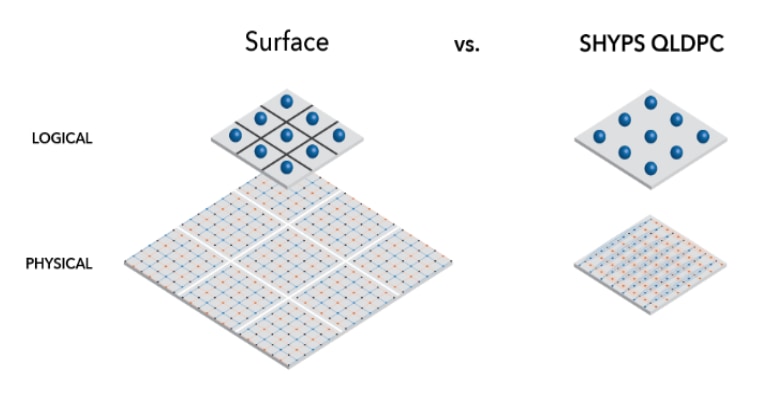
Surface (left) and SHYPS (right) code implementations of 9 logical qubits requires as many blocks of code. Since each block of code requires many physical qubits, the surface code implementation’s blocks together are composed of a much larger number of physical qubits. The number of physical qubits needed for SHYPS implementation of comparable performance is drastically lower than that
Efficient quantum computation is the ability of a quantum system to do more with less, be it physical resources, time, or the number of operations to complete a program. Two main factors that influence efficiency are the physical to logical qubit ratio, and the ability to run efficient logical operations.
Physical to Logical Qubit Ratio: A good ratio — or rate — makes commerciallyrelevant quantum more practically feasible by lowering the number of physical qubits needed, reducing the size and cost of systems needed to run large application.
With surface codes, each code block – made of hundreds or thousands of physical qubits – can only hold one single logical qubit. In contrast, QLDPC codes can encode multiple logical qubits in a single code block. As a result, they can be structured to have much lower overheads. To achieve nine logical qubits with surface code requires nine blocks of surface code. With a small SHYPS code, it is possible to get nine logical qubits using only a single block of code. Simply put, QLDPC codes generate more logical qubits per physical qubit. Increasing the size of a SHYPS code (i.e., including more physical qubits) enables more logical qubits to be encoded per block whereas increasing the size of the block of surface code will still result in only a single logical qubit. SHYPS increases efficiency of quantum computation by decreasing the total physical qubit resource requirements needed.
Efficient Logical Operations: Error-correcting codes must support quantum logic by providing a universal gate set that can be efficiently compiled to execute the full range of calculations required by complex algorithms. The fewer steps (i.e., lower circuit depth) needed to complete these calculations, the faster the run time.
To understand the need for efficient operations, it helps to start with how a quantum circuit works. A quantum circuit is a series of logical operation steps that run across a set number of logical qubits. A logical operation is a gate or set of gates. When completed in combination with other logical operations, they complete a program or algorithm. The more steps a circuit has, the greater the circuit depth. Surface codes are best-in-class for compilation depth (i.e., number of steps). Photonic’s new SHYPS codes can implement algorithms in a depth similar to that achieved by surface codes. This is extraordinary, considering surface codes have been under development and optimization for decades. Further improvements in SHYPS efficiency are expected as research and development of these and other QLDPC codes continues.
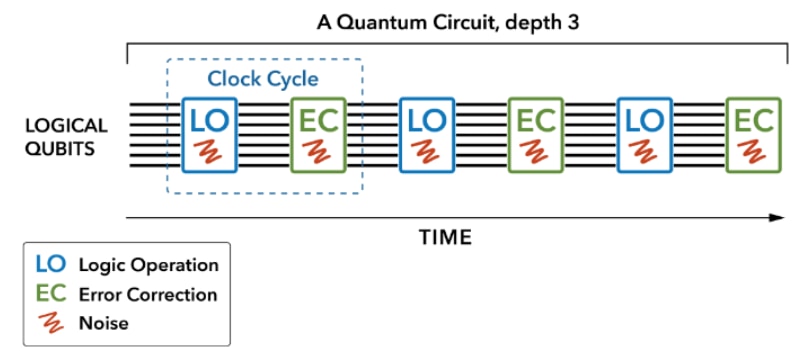
Quantum computers in an error-corrected setting complete an error-correction step after performing each logic step in a circuit. Each of these steps (i.e., logical operation and error correction) can introduce new errors — or noise — so the system has to be able to manage errors by correcting them as they continue to occur.
Error correction is the process of checking for errors and correcting them. A single error correction step involves first querying the system to determine if an error occurred, then decoding the information returned by the query, and finally, fixing the error if necessary. Good error correction benefits from single shot capabilities, fault tolerant operations, and good error suppression performance.
Single-Shot Capabilities: In single-shot systems, the code only needs to “check for errors” once per logical operation. The more times a code needs to “check errors” between operations, the slower the code runs, and the more computationally challenging (and therefore time consuming and hardware intensive) decoding at the end of the program will be.
Surface codes have logic implementations that require 30 measurements in a single clock cycle (that is, one logic operation step and one error correction step) for commercialgrade logic. SHYPS codes, in contrast, have single-shot properties, meaning that a single measurement is sufficient for error correction — this leads to a 30x speedup of the logical clock cycle.
Fault-Tolerant Operations: The code needs to be structured to prevent errors from spreading during operations and errorcheck steps. The system needs to manage errors as they occur.
A fault-tolerant implementation is necessary for a practical quantum error correction implementation. Beyond error detection and correction, fault-tolerance involves structuring the operations to minimize the spread of errors when they do occur. In fault-tolerance, “an ounce of prevention is worth a pound of cure.” Containing the spread of errors based on how the logical operation is built means less error detection and correction will be required at each error correction step. Cleaning up a contained error at the source is faster and requires fewer resources than tracking it across the circuit. The SHYPS codes attain fault-tolerance in all of the logic steps needed for a universal quantum computer. For a detailed discussion on how this is achieved, please refer to the appendix of the scientific paper.
Good Error Suppression Performance: The code needs the ability to suppress errors that occur between error correction steps. This is typically quantified as the pseudothreshold by the error correction community. Codes with good pseudothreshold performance are able to successfully complete the logical operations and not get overwhelmed by the noise introduced during the process.
The ability of SHYPS codes to correct errors is competitive with the current standard set by surface codes. For a code with a given number of physical qubits, small SHYPS codes have demonstrated competitive pseudothresholds with the surface code while still providing more logical qubits per physical qubit.
In summary, SHYPS codes demonstrate all of the requirements to enable efficient, large-scale, error corrected quantum computing. They provide both good error correction capabilities and, importantly, the means for efficient quantum computation — the previously unsurmountable challenge for QLDPC. There is still one additional requirement for QLDPC codes that will impact implementation: connectivity.
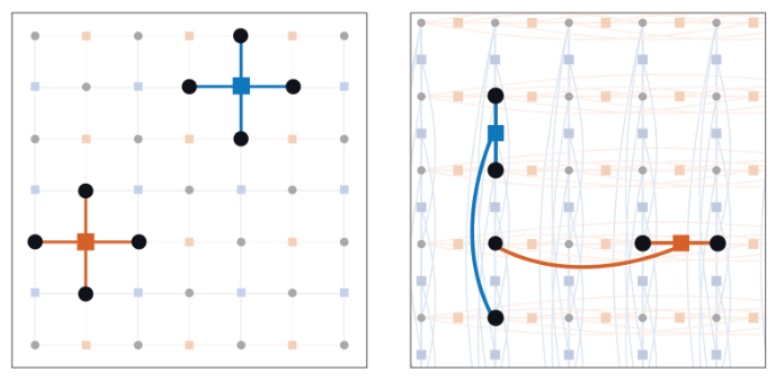
Connectivity diagrams for portions of surface (left) and SHYPS (right) codes. Physical qubits that are used to encode information and do calculations are denoted as circles, while the additional qubits used to detect bit flip errors are shown in orange and phase flip errors in blue. Surface codes rely on local connections while SHYPS codes require connections to qubits that are not situated next to each other.
Error correction codes are not architecture agnostic. This means that not all codes can be run efficiently on all quantum computers, and not all quantum computers can run all types of codes. The ability to run a quantum error-correcting code on a given hardware architecture is dependent upon the connectivity of that hardware. Surface codes have nearest-neighbour connectivity needs, while QLDPC codes have more complex, nonlocal connectivity requirements.
Nearest-Neighbour Connectivity: This approach requires connecting each qubit to the four adjacent qubits on the plane — its nearest neighbours. Surface codes offer an effective implementation of error correction for quantum computers with connections to only physically close, local qubits needed. The impact that surface codes have had on quantum computing system design is often underappreciated. As surface codes have been the dominant approach, and are implementable across many modalities, quantum computer architectures have typically been built to implement this type of error correction. As a result, non-local connectivity capabilities have not been prioritized. The implication of this focus means that architectures designed only for nearestneighbour connections are also restricted to the capability limitations of surface code and are saddled with its overheads.
Non-Local Connectivity: This approach means that qubits can connect to qubits beyond those adjacent on the plane — to non-local qubits. Non-local connectivity removes the reliance on surface codes and therefore the requirement for the huge overheads inherent in surface code implementation.
Photonic’s architecture is intentionally designed for high nonlocal connectivity. The company has taken a systems engineering approach to understanding the requirements necessary to build an efficient, fault-tolerant computer, capable of scaling up to meet the demands of complex algorithms. One guiding principle is to be able to leverage the efficiencies made available through a non-surface code approach to error correction for large-scale quantum computing.
The quantum computing industry has only relatively recently begun to understand the limitations of building for surface code requirements on how quantum computers are designed and operate. There is growing recognition of, and interest in, the opportunities that exist for more efficient error correction codes requiring far fewer qubits to run the same quantum algorithms.
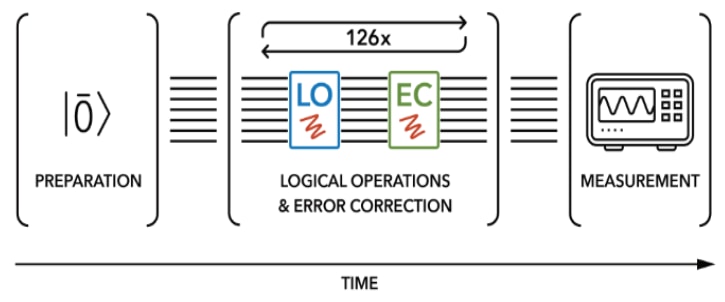
Fault-tolerant simulation shows SHYPS can go the distance. An error-corrected calculation begins with a state preparation, followed by several logical clock cycles (each including a logical operation and error correction step), and finishes with a measurement to return results. In a fault-tolerant setting, each of these steps is constructed to prevent the spread of errors beyond what the code can correct. Photonic’s recent result includes a fault-tolerant simulation of two blocks of a SHYPS code (98 data qubits total) for 126 clock cycles, showing that these codes can perform in practice as error rates remained consistent with shorter memory simulations (error buildup during logic is well managed).

Connectivity diagrams of surface (left) and SHYPS (right) codes in practice. In a full implementation of SHYPS codes and comparably scaled implementation of surface codes, SHYPS codes rely on nonlocal connectivity across and between chips while surface codes rely on nearest-neighbour connectivity across chips and edgecoupling between chips (neighbouring or otherwise).
Record Breaking Simulation of Logic: To demonstrate these SHYPS codes can efficiently execute fault-tolerant computing, Photonic completed a simulation of the operation of a small SHYPS code in a noisy environment. In possibly the most complex simulation of quantumerror-corrected logic to date, the simulation implemented a depth-126 logical operation followed by error correction steps using two blocks of code, each composed of 49 physical qubits to create 9 logical ones. The code sustained performance that was comparable to a memory simulation while performing logic, indicating that logic implementations do not introduce errors beyond what the code can demonstrably correct under memory. This means that the code is robust to errors while operating.
This work demonstrates that QLDPC codes, like the fast and lean SHYPS code family, are a viable path towards practically feasible, large-scale quantum computers. By unlocking the ability to perform efficient error-corrected computation in a highly-connected architecture, this work demonstrates that QLDPC codes are capable of driving down physical overheads, while simultaneously decreasing time overheads.
In computation, both size and speed matter. SHYPS codes are more resource-efficient than surface codes in terms of physical qubit count. Surface codes are famously very time-efficient: it takes very few logical clock cycles to implement logical operations. Fortunately, performing logic in SHYPS codes does not increase the runtime compared to surface codes even with the notable reduction in physical overhead. These SHYPS codes are competitive with the surface code in the number of logical clock cycles it takes to compute, and due to faster error correction, each of these steps runs faster. Alongside these improvements in runtime and resource requirement are performance increases for codes of a given physical qubit count. The net effect is an astonishingly effective quantum error-correction implementation.
These findings highlight the critical role of high-connectivity architectures in building scalable quantum systems. Non-local connectivity offers key advantages for distributed quantum computing, particularly when combined with QLDPC approaches in architectures that support it. QLDPC codes broadly — and the SHYPS family specifically — can only be effectively implemented in hardware capable of handling complex non-local connections. Photonic’s high-connectivity Entanglement First™ architecture enables the use of QLDPC codes, providing fast and efficient solutions to error correction challenges that other quantum modalities struggle to overcome.
Photonic has developed the first QLDPC code that can compute with efficiency competitive with the surface code. This breakthrough in error correction upends the assumptions of surface codes’ overhead requirements, accelerating the timeline to commercially-relevant quantum computing. Efficient error correction means commercially relevant algorithms can be run on systems with far fewer physical qubits than previously predicted. Photonic’s SHYPS code family represents the start of a better error correction era for quantum technologies.